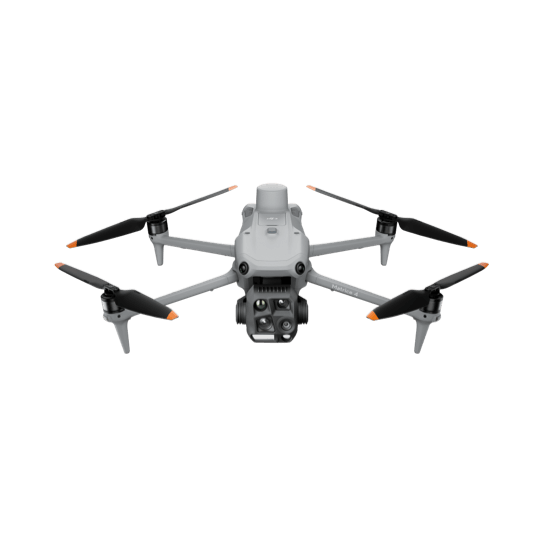
RGB and thermal capture are not interchangeable. They answer different questions, and understanding which question you are actually asking determines which dataset you need - and whether you need both.
RGB aerial imagery produces a high-resolution visual record of an asset as it exists at a point in time. Processed into a georeferenced orthomosaic, it gives you an accurate, scaled, top-down map of the full site with GPS coordinates tied to every pixel. Processed further, it produces 3D models and point clouds suitable for volume calculations, structural reference, and change detection over time.
For asset management purposes, RGB capture is the condition documentation layer. It records what is physically present - panel layout, access road condition, vegetation encroachment, perimeter integrity, structural changes, and site progress. It is the baseline against which change is measured.
For construction documentation, RGB is typically sufficient at most milestone stages. The record you need is visual - what was built, when, and in what configuration. For solar arrays, RGB alone tells you what the array looks like. It will not tell you which panels are underperforming.
Thermal capture identifies temperature differential across a surface. For solar assets, that differential is the signal - hotspots, string anomalies, bypass diode failures, and PID-affected modules all present as temperature deviations invisible to an RGB sensor.
For electrical infrastructure and plant, thermal identifies resistance-related heating in terminations, connections, and components operating outside their normal thermal envelope.
Thermal without RGB is operationally incomplete for most asset types. You have anomaly locations, but you are missing the spatial context that allows a maintenance team to navigate to them efficiently.
For solar arrays - always. Thermal identifies the anomalies. RGB provides the spatial reference. An annotated orthomosaic with thermal findings overlaid gives your O&M team exactly what they need to act: a located fault on a map they can navigate from.
For large industrial facilities, both sensors running simultaneously gives you thermal anomaly data alongside a current-state visual record of the full asset. The RGB dataset supports maintenance planning, contractor briefing, and regulatory documentation. The thermal dataset supports fault identification and asset condition monitoring.
For scheduled monitoring programs, running both sensors on every visit means your change detection capability covers both visual change and thermal change - two independent indicators of asset condition tracked over time.
RGB only is appropriate for construction milestone documentation where the deliverable is a timestamped visual record. It is also appropriate for vegetation management, access road condition monitoring, and perimeter integrity checks where thermal adds no value to the specific question being asked.
Thermal only is rarely the right answer for a first capture. Without the RGB context layer, anomaly locations are harder to act on and the dataset has limited standalone value for reporting purposes.
The practical default for commercial and industrial assets is both sensors, every visit. The marginal cost of running RGB alongside thermal is negligible. The value of having both datasets is not.
Every industry, one standard
Utility-scale solar, a commercial rooftop array, or a single roof - captured to the same standard and read by the same certified thermographer. Tell us what you're working with and we'll come back to you with what the data shows, not a generic quote.
We don't quote until we understand the site. Use the chat in the corner, or see what's included below.
Brisbane, Queensland
South East Queensland & Northern New South Wales
SkySpectra provides aerial thermal and RGB data capture services, including thermographic assessment of thermal imagery by an ITC Level 1 Certified Thermographer. This assessment identifies and classifies thermal anomalies but is not a structural, electrical, or engineering assessment, and does not constitute certification of any asset. Any decision regarding remediation, repair, or compliance must be made by an appropriately qualified professional engaged by the client.