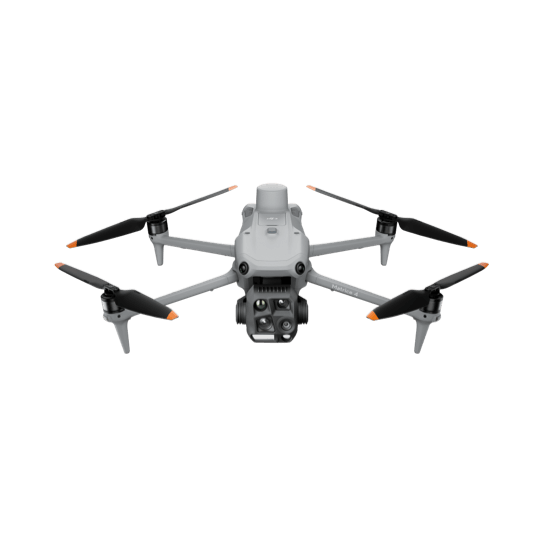
Thermal imaging detects surface temperature differential. Before anything else, that precision matters - because the gap between what thermal capture actually does and what asset owners sometimes expect it to do is where misaligned expectations create problems.
A thermal camera measures emitted infrared radiation and converts it to a temperature map. What you see in a thermal dataset is not an image of the asset - it is a representation of relative heat across a surface. Components operating outside their normal thermal signature stand out. Components within expected parameters do not.
This is the core value for asset management: thermal anomalies are often the earliest detectable indicator of a developing fault - appearing weeks or months before any measurable performance degradation shows up in SCADA data, string monitoring, or visual inspection.
On a large-scale PV array, thermal drone capture conducted under appropriate irradiance conditions will identify hotspots at cell and module level, bypass diode failures producing characteristic multi-cell patterns, string-level deviations indicating inverter or combiner issues, and PID-affected modules showing systematic temperature drift across string groups.
An inverter dashboard tells you a string is underperforming. Thermal capture tells you which module, where it sits in the array, and what its temperature deviation looks like relative to adjacent panels.
The value over string-level monitoring is resolution. That is the difference between knowing you have a problem and knowing where to send a technician.
On switchgear, transformers, cable terminations, and distribution equipment, thermal imaging identifies resistance-related heating - overloaded connections, failing terminations, unbalanced phases, and cooling system anomalies. These faults follow a predictable thermal progression: elevated temperature precedes failure. Scheduled thermal capture creates a documented baseline against which progression can be tracked.
For large processing facilities and plant, aerial thermal capture removes the access constraints that make ground-level thermography slow and incomplete. A single flight covers the full asset footprint - rooftop plant, electrical infrastructure, pipework, and structural envelope - in a timeframe that ground-based methods cannot match.
Thermal data identifies anomalies. It does not diagnose root cause, quantify remaining service life, or constitute an engineering assessment. A hotspot on a module tells you that module is behaving differently from its neighbours. Whether the cause is a manufacturing defect, physical damage, soiling, or an electrical fault requires a qualified assessor on the ground.
SkySpectra delivers GPS-located anomaly data. What that data means for your maintenance program, warranty position, or compliance obligations is a determination made by your engineering and O&M team - with a dataset precise enough to act on.
For PV array capture, minimum irradiance of 600W/m2 is required for reliable anomaly detection. Below that threshold, the temperature differential between healthy and degraded modules narrows to the point where confident identification becomes unreliable. We do not fly thermal in marginal conditions and deliver data that cannot be stood behind.
For electrical infrastructure and plant, capture timing is determined by operational state - equipment should be under representative load conditions for thermal signatures to be meaningful.
If conditions are not right, we reschedule. A dataset captured in the wrong conditions is not a dataset worth acting on.
Every industry, one standard
Utility-scale solar, a commercial rooftop array, or a single roof - captured to the same standard and read by the same certified thermographer. Tell us what you're working with and we'll come back to you with what the data shows, not a generic quote.
We don't quote until we understand the site. Use the chat in the corner, or see what's included below.
Brisbane, Queensland
South East Queensland & Northern New South Wales
SkySpectra provides aerial thermal and RGB data capture services, including thermographic assessment of thermal imagery by an ITC Level 1 Certified Thermographer. This assessment identifies and classifies thermal anomalies but is not a structural, electrical, or engineering assessment, and does not constitute certification of any asset. Any decision regarding remediation, repair, or compliance must be made by an appropriately qualified professional engaged by the client.